为了帮助你更好地准备,我将为你提供一份高度仿照育龙单招网风格和难度的模拟单招试题,这份试题将涵盖语文、数学、英语三大公共文化课,并附上详细的答案和解析,让你能够进行一次完整的自我检测。
育龙单招网模拟试题(2025版)
考试时间: 90分钟 满分: 200分
第一部分:语文(共60分)
单项选择题(每小题3分,共18分)
-
下列词语中,加点字的读音全都正确的一项是( ) A. 拙劣 (zhuō) 拗口 (ào) 炽热 (zhì) B. 愀然 (qiǎo) 舐犊 (shì) 踱步 (duó) C. 剽悍 (piāo) 龃龉 (jǔ) 蹙眉 (cù) D. 诘问 (jí) 庇佑 (bì) 龛位 (kān)
-
下列句子中,没有错别字的一项是( ) A. 这篇文章立意新颖,结构严谨,堪称不刊之论。 B. 春节期间,火车站里人声顶沸,旅客们都在焦急地等待回家的列车。 C. 他做事总是按部就班,从不标新立异,因此深得领导的赏识。 D. 这幅画色彩斑澜,意境深远,给人以强烈的艺术震撼。
-
依次填入下列各句横线处的词语,最恰当的一项是( ) (1)在科技日新月异的今天,我们每个人都应该不断学习,否则就会__时代。 (2)面对困难,我们不能__,而应该积极寻找解决问题的办法。 A. 脱离 退缩 B. 脱节 退却 C. 脱离 退却 D. 脱节 退缩
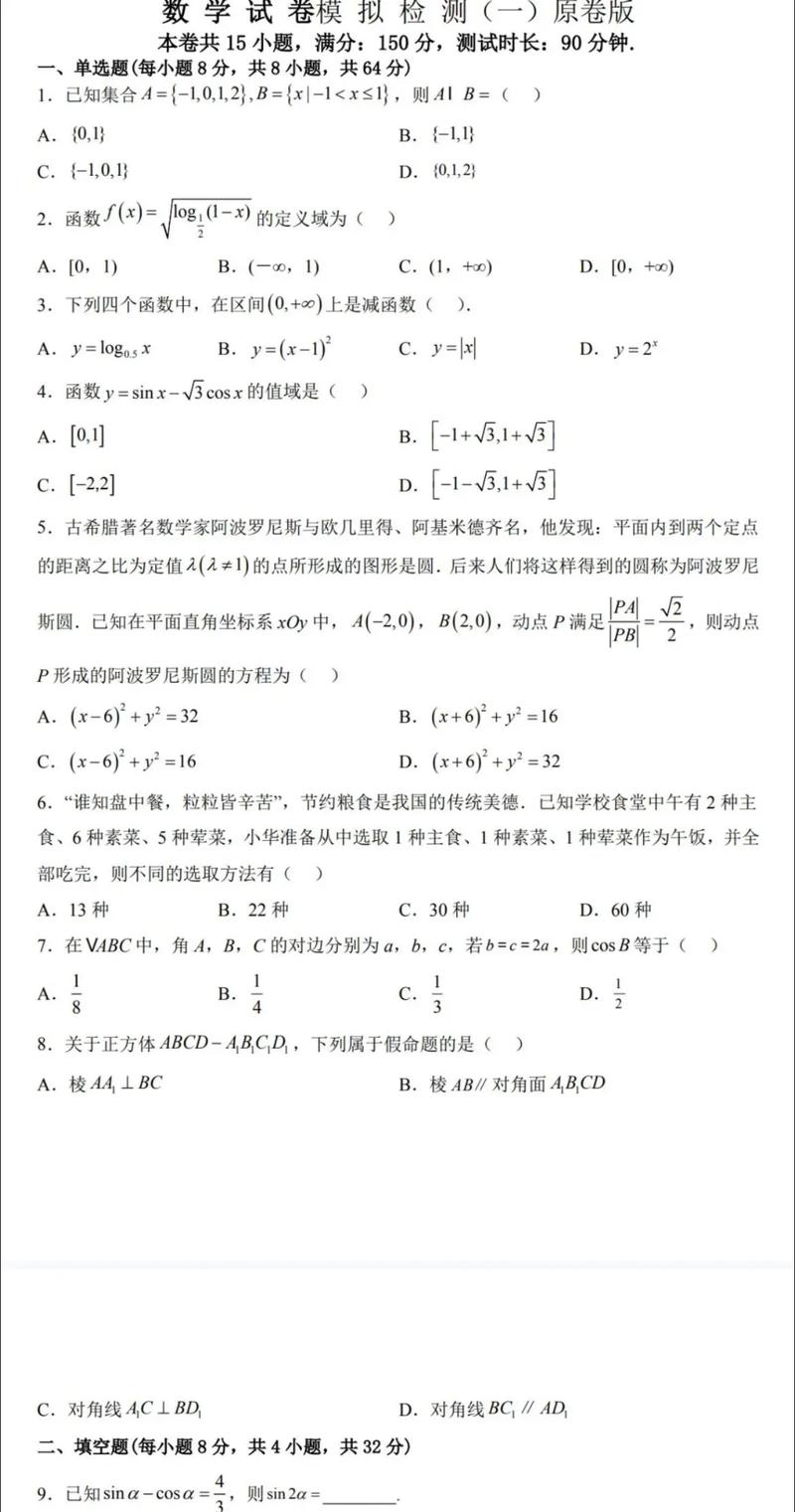 (图片来源网络,侵删)
 -
下列各句中,加点成语使用不恰当的一项是( ) A. 这位老教授学识渊博,在学术界德高望重,说起话来总是不瘟不火。 B. 为了完成这项艰巨的任务,大家同心协力,攻坚克难,终于取得了胜利。 C. 这部电影情节跌宕起伏,扣人心弦,看得观众们屏息敛声。 D. 他刚取得一点成绩就沾沾自喜,这种骄傲自满的态度是不可取的。
-
下列句子没有语病的一项是( ) A. 通过这次社会实践活动,使我们开阔了眼界,增长了才干。 B. 能否坚持体育锻炼,是身体健康的重要保证。 C. 为了防止这类交通事故不再发生,交警部门加强了路面巡查。 D. 学校开展的“经典诵读”活动,极大地激发了同学们学习传统文化的热情。
-
下列关于文学文化常识的表述,不正确的一项是( ) A. 《诗经》是我国最早的一部诗歌总集,内容分为“风、雅、颂”三部分。 B. “唐宋八大家”是唐代和宋代八位著名散文家的合称,其中包括韩愈、柳宗元、欧阳修、苏轼等。 C. 鲁迅是我国现代文学的奠基人,他的小说集《呐喊》收录了《狂人日记》《阿Q正传》《祝福》等名篇。 D. “豆蔻”指女子十三四岁,“弱冠”指男子二十岁,“耄耋”指八九十岁。
阅读理解(共22分)
(一)阅读下面的文字,完成7-9题。(每小题4分,共12分)
谈静
朱光潜
①人生乐趣一半得来自活动,也还有一半得来自感受,所谓“感受”是被动的,是容许事物在心里来往驻足,有些人感觉敏锐,心情能随时领略到趣味,好像花树迎风欣然舞起,或是Into into the joy of things,他们能处处领略趣味,所以他们的生活丰富,有些人感觉麻木,心里没有安排去领略趣味,于是兴趣索然,终日 bored and weary,免不了变成“无情”的人,我所谓“静”,便是指心界的空灵,不是指物界的沉寂,物界永远不沉寂的,你的心境愈空灵,你愈不觉得物界沉寂,或者我还可以进一步说,你的心界愈空灵,你也愈不觉得物界喧嘈,习静并不一定要到万籁俱寂的地方去,所谓“正位凝命”,随时随地都习静,如果心境原本是空灵的,你可以随时随地领略趣味,习静工夫很难,但并不是做不到,我们只要能做到第一层,能够领略趣味,便不受世俗的牵绊,就可以不为物欲所奴役了。
②静的修养不仅是可以使你领略趣味,还可以使你领悟人生的真谛,宇宙万物,无一不是静静地在那里存在,人类可以说是惟一能活动的动物,所以人比一切万物都更爱动,其实能活动者固然是人生之趣,但不能动时也未必是苦,老子说:“有无相生,难易相成,长短相较,高下相倾。”这话精妙极了,活动与不生,都是人生的趣味,懂得这一层,我们就可以不为环境所苦了,在百忙中,在尘世喧嚷中,你偶然丢开一切,悠然遐想,你心中便蓦然似有一道灵光闪烁,无穷之意境涌现,这就是忙里偷闲,苦中作乐。
③静的修养可以帮助我们养成一种临大事而不乱的定力,许多青年人觉得定力很难修养,其实定力并不是神秘的,它只是寻常的忍耐工夫罢了,所谓“定”,只是心有所主,不轻易为外物所摇动而已,我们如果能时常丢开一切,欣赏一回飞鸟云彩,或在深夜里静听秋虫的鸣声,也同样是训练定力的工夫,有了这种定力,我们才能“泰山崩于前而色不变”,才能在人生的紧要关头,保持清醒的头脑,做出正确的判断。
-
根据原文,下列不属于“静”的范畴的一项是( ) A. 心界的空灵,能容纳事物的往来。 B. 在喧嚣的环境中,依然能领略到趣味。 C. 身体不活动,感觉无聊痛苦。 D. 丢开一切,悠然遐想,涌现无穷意境。
-
下列对原文内容的理解和分析,不正确的一项是( ) A. 第①段中,作者通过对比“感觉敏锐”和“感觉麻木”的人,说明了感受力对生活趣味的重要性。 B. 第②段引用老子的话,是为了说明动与静、难与易等都是相对的,活动与不活动都是人生的乐趣。 C. 第③段认为,定力是神秘的,只有通过修身养性才能获得,普通人很难做到。 D. 本文的中心论点是,静的修养不仅能带来生活的乐趣,还能帮助我们领悟人生真谛和培养定力。
-
结合全文,谈谈我们应该如何进行“静”的修养。(4分)
(二)古诗文默写(共10分)
- 补写出下列名篇名句中的空缺部分。 (1),长河落日圆。(王维《使至塞上》) (2)但愿人长久,。(苏轼《水调歌头·明月几时有》) (3)学而不思则罔,。(《论语》) (4),病树前头万木春。(刘禹锡《酬乐天扬州初逢席上见赠》) (5)人生自古谁无死,___。(文天祥《过零丁洋》)
作文(共20分)
-
阅读下面的材料,根据要求写作。
一位登山者在攀登一座高山时,遇到了一位正在山脚下休息的智者,登山者问:“我怎样才能登上山顶?”智者没有直接回答,而是反问道:“你为什么想要登上山顶?”登山者说:“因为山顶有最美的风景。”智者说:“沿途的风景同样美丽,当你到达山顶时,你可能会发现,最美的风景其实就在你走过的路上。”
请结合以上材料,自选角度,自拟题目,写一篇不少于600字的文章,文体不限(诗歌除外)。
第二部分:数学(共60分)
单项选择题(每小题5分,共25分)
-
已知集合 A = {x | x² - 4 < 0},集合 B = {1, 2, 3},则 A ∩ B = ( ) A. {1, 2} B. {1, 2, 3} C. {2, 3} D. {1, 3}
-
函数 f(x) = log₂(x - 1) 的定义域是( ) A. (1, +∞) B. [1, +∞) C. (-∞, 1) D. (-∞, 1]
-
已知等差数列 {aₙ} 的前n项和为 Sₙ,若 a₂ = 5,S₅ = 25,则该数列的公差 d = ( ) A. 1 B. 2 C. 3 D. 4
-
已知向量 a = (2, 1),b = (x, -3),且 a ⊥ b,则 x 的值为( ) A. -2 B. -3/2 C. 3/2 D. 2
-
一个圆锥的底面半径为3,高为4,则该圆锥的体积为( ) A. 12π B. 16π C. 24π D. 36π
填空题(每小题5分,共15分)
-
在 (2x - 1)⁵ 的二项展开式中,x² 项的系数是 ____。
-
已知 sinα = 3/5,且 α 是第二象限角,则 cosα = ____。
-
一个盒子里有5个大小相同的小球,其中3个是红球,2个是白球,从中随机取出2个小球,取出的2个小球颜色相同的概率是 ____。
解答题(共20分)
-
(10分) 已知 △ABC 的三个内角 A, B, C 的对边分别为 a, b, c,且满足 b cos C + c cos B = 2a cos A。 (1) 求角 A 的大小; (2) 若 a = 2√3,b = 4,求 △ABC 的面积。
-
(10分) 已知函数 f(x) = x² - 2x - 3。 (1) 求函数 f(x) 的零点; (2) 求函数 f(x) 在区间 [0, 3] 上的最大值和最小值。
第三部分:英语(共80分)
单项选择题(每小题3分,共30分)
-
— ___ is the nearest hospital from here? — It's about 10 minutes' walk. A. How B. What C. Where D. How far
-
I'm sorry I ___ my homework at home this morning. A. forgot B. left C. missed D. lost
-
— Would you like some more coffee? — ___. I've had enough. A. No, thanks B. Yes, please C. That's right D. I agree
-
The book ___ you lent me yesterday is very interesting. A. who B. which C. what D. whom
-
It's raining heavily. You'd better ___ a raincoat with you. A. take B. to take C. taking D. taken
-
This is the school ___ I studied three years ago. A. which B. where C. when D. who
-
— What's your plan for the summer vacation? — I ___ to the countryside with my parents. A. go B. went C. have gone D. am going
-
The teacher spoke very slowly and clearly ___ we could understand him. A. so that B. because C. if D. though
-
— I won the first prize in the speech contest. — ___! You are so great. A. Good luck B. That's too bad C. Congratulations D. No problem
-
I prefer at home to out on such a cold day. A. stay; go B. to stay; go C. staying; going D. staying; go
完形填空(每小题2分,共20分)
As a child, I was always told that the early bird catches the worm. But I never really understood it until I was 11 years old.
That year, my father took me on a fishing trip. We woke up 11 in the morning, while it was still dark. I was very sleepy and didn't want to get out of my warm 12 . But my father just smiled and said, "Come on, son. The best time to fish is early in the morning."
We arrived at the lake just as the sun was rising. The lake was 13 and quiet. We put our fishing rods into the water and waited. After about half an hour, I felt a 14 on the line. I pulled it out, and it was a beautiful fish! I was so excited.
My father smiled and said, "See? The early bird catches the worm." I nodded, 15 that I finally understood the meaning of this old saying.
From that day on, I learned that 16 and effort are important. If you want to succeed, you have to be willing to get up early and work hard. It's not just about fishing. It's about 17 . Whether you're studying for a test or working on a project, the same rule applies.
Now, I always try to be an "early bird". I know that the 18 I start, the more I can achieve. This lesson from my father has stayed with me 19 and has helped me a lot in my life. I am thankful for that 20 morning by the lake.- A. early B. late C. quickly D. slowly
- A. bed B. lake C. car D. bag
- A. noisy B. busy C. calm D. dirty
- A. pull B. push C. hit D. bite
- A. hoping B. thinking C. guessing D. realizing
- A. laziness B. pride C. patience D. fear
- A. fishing B. sleeping C. life D. playing
- A. later B. earlier C. harder D. easier
- A. ever B. never C. always D. sometimes
- A. tiring B. boring C. unforgettable D. dangerous
阅读理解(共20分)
A
Now, more and more people are choosing to travel by high-speed rail. It is fast, comfortable, and convenient. Here are some tips for you when you travel by high-speed rail in China.
**Buying Tickets**
You can buy tickets at the station ticket office, or use a special app on your phone. It's very easy to use the app. Just enter your departure city, arrival city, and travel date. The app will show you all the available trains and times. You can pay for your ticket online with Alipay or WeChat Pay.
**Checking In**
You don't need to stand in a long line to get your paper ticket. You can use your phone to get a QR code ticket. At the station, find the self-service check-in machine. Put your ID card on the machine, and it will print your boarding pass for you. Then, you can go through the security check.
**Boarding the Train**
Your boarding pass will show your carriage number and seat number. Look for the signs on the platform to find your carriage. The train will only stop for a few minutes, so be ready to board when it arrives.
**On the Train**
High-speed trains are very clean and modern. Each seat has a power socket where you can charge your phone or laptop. You can also use free Wi-Fi on the train. The attendants are very helpful and will bring you water or help you with your luggage.
High-speed rail travel is a great way to see China. It's fast, easy, and comfortable.-
How can you pay for your high-speed rail ticket? (2分)
-
What do you need to do at the self-service check-in machine? (2分)
-
What can you find on your boarding pass? (2分)
-
Is it allowed to use your phone on the high-speed train? (2分)
-
What is the main idea of this passage? (2分)
B
Albert Einstein was born in Germany in 1879. As a child, he was not a good student. His teachers thought he was slow and lazy. He didn't like to follow school rules and often asked questions that his teachers couldn't answer.
When he was young, Einstein was very interested in science. He loved to think about how the universe worked. He didn't just read books about science; he also did many experiments by himself. He often sat for hours, thinking and writing in his notebook.
In 1905, Einstein published a paper that changed the world. It was about the theory of relativity. This new idea explained things that people had wondered about for centuries. For example, it showed that time and space are not fixed. They can change depending on how fast you are moving.
Einstein became famous all over the world. He won the Nobel Prize in Physics in 1921. But he remained a simple man. He loved to play the violin and sail boats. He was also a kind man who cared about peace and justice.
Einstein died in 1955, but his ideas are still very important today. He is remembered as one of the greatest scientists in history.-
What did Einstein's teachers think of him when he was a child? (2分)
-
What did Einstein love to do in his free time? (Please give two examples) (2分)
-
When did Einstein publish his famous paper on the theory of relativity? (2分)
-
Why is Einstein still remembered today? (2分)
-
What can we learn from Einstein's story? (2分)
参考答案与解析
第一部分:语文
单项选择题
- B (A项“炽”读chì;C项“龃”读jǔ;D项“诘”读jié)
- A (B项“顶沸”应为“鼎沸”;C项“按部就班”是正确的;D项“斑澜”应为“斑斓”)
- A (“脱离”指离开某种环境、关系或范围,符合语境。“退缩”指在困难或面前后退,符合语境。)
- A (“不瘟不火”指表演既不沉闷也不火爆,恰到好处,用来形容说话不恰当。)
- D (A项成分残缺,去掉“通过”或“使”;B项两面对一面,去掉“能否”;C项否定失当,去掉“不”或“防止”。)
- C (《祝福》是鲁迅的小说集《彷徨》中的作品。)
阅读理解 7. C (根据第①段,“静”是一种心境,能感受乐趣,C项“感觉无聊痛苦”与“静”带来的乐趣相反。) 8. C (根据第③段,“定力并不是神秘的,它只是寻常的忍耐工夫罢了”,所以C项说“定力是神秘的”是错误的。) 9. 答案示例: (1)要时常保持心界的空灵,不为物欲所牵绊。 (2)要学会在百忙和喧嚣中,丢开一切,悠然遐想,欣赏自然景物。 (3)通过欣赏飞鸟云彩、静听虫鸣等方式,来训练自己临大事而不乱的定力。
古诗文默写 10. (1)大漠孤烟直 (2)千里共婵娟 (3)思而不学则殆 (4)沉舟侧畔千帆过 (5)留取丹心照汗青
作文 11. 评分标准:
- 立意(8分): 紧扣材料,中心明确,如:过程比结果更重要;享受过程,发现沿途的风景;最美的风景在路上;目标与过程的关系等。
- 结构(6分): 结构完整,层次清晰,开头点题,中间论证,结尾升华。
- 内容(4分): 论据充分,内容充实,可以结合个人经历、名人故事、社会现象等。
- 语言(2分): 语言流畅,表达准确。
写作思路点拨:
- 反对只盯着山顶: 批评那些为了功利目标而忽略生活本身的人。
- 赞美沿途的风景: 强调过程中的学习、成长、体验和感悟才是人生最宝贵的财富。
- 辩证看待: 目标(山顶)和过程(沿途)同样重要,但过程是实现目标的唯一途径,且过程本身也充满价值。
- 联系自身: 可以写自己在学习、比赛、生活中的经历,说明如何从只看重分数/名次,到学会享受努力的过程。
第二部分:数学
单项选择题
- A (A = {x | -2 < x < 2}, A ∩ B = {1})
- A (x - 1 > 0, x > 1)
- A (由 a₂ = a₁ + d = 5, S₅ = 5a₁ + 10d = 25,解得 a₁ = 3, d = 1)
- C (a · b = 2x - 3 = 0, x = 3/2)
- A (V = (1/3)πr²h = (1/3)π 3² 4 = 12π)
填空题 6. 40 (T₃ = C(5,2) (2x)³ (-1)² = 10 8x³ 1 = 80x³,T₄ = C(5,3) (2x)² (-1)³ = 10 4x² (-1) = -40x²,所以x²项的系数是-40。更正:通项公式 T_{r+1} = C(5,r) (2x)^{5-r} (-1)^r,令 5-r=2, r=3,T₄ = C(5,3) (2x)² (-1)³ = 10 4x² * (-1) = -40,所以系数是-40。) 7. -4/5 (cos²α = 1 - sin²α = 1 - (9/25) = 16/25,因为α在第二象限,所以cosα < 0,故cosα = -4/5) 8. 2/5 (P = (C(3,2) + C(2,2)) / C(5,2) = (3 + 1) / 10 = 4/10 = 2/5)
解答题 9. 解: (1) 根据余弦定理,b cos C + c cos B = a。 又已知 b cos C + c cos B = 2a cos A。 a = 2a cos A。 因为 a ≠ 0,cos A = 1/2。 又因为 0 < A < π,A = π/3 (或 60°)。
(2) 由余弦定理 a² = b² + c² - 2bc cos A,
(√3)² = 4² + c² - 2 * 4 * c * cos(π/3),
12 = 16 + c² - 4c,
c² - 4c + 4 = 0,
(c - 2)² = 0,
c = 2。
再由正弦定理 a / sin A = b / sin B,
2√3 / sin(π/3) = 4 / sin B,
2√3 / (√3/2) = 4 / sin B,
4 = 4 / sin B,
sin B = 1,B = π/2 (或 90°)。
C = π - A - B = π - π/3 - π/2 = π/6 (或 30°)。
S△ABC = (1/2) * b * c * sin A = (1/2) * 4 * 2 * sin(π/3) = 4 * (√3/2) = 2√3。
*或者* 因为B=90°,所以S = (1/2) * a * c * sin B = (1/2) * 2√3 * 2 * 1 = 2√3。-
解: (1) 令 f(x) = 0,即 x² - 2x - 3 = 0。 因式分解得 (x - 3)(x + 1) = 0。 x₁ = 3, x₂ = -1。 函数 f(x) 的零点是 -1 和 3。
(2) 函数 f(x) = x² - 2x - 3 的图象是一条开口向上的抛物线,其对称轴为 x = -b/(2a) = 2/(21) = 1。 对称轴 x = 1 在区间 [0, 3] 内。 f(1) = 1² - 21 - 3 = -4。 f(0) = 0² - 20 - 3 = -3。 f(3) = 3² - 23 - 3 = 0。 比较可知,函数在区间 [0, 3] 上的最小值是 -4,最大值是 0。
第三部分:英语
单项选择题
- D (询问距离用 How far)
- B (leave sth. + 地点,表示“把...忘在...地方”)
- A (根据后半句“我已经喝够了”,表示拒绝,用 No, thanks)
- B (指物,在定语从句中作宾语,用 which)
- A (had better do sth.)
- B (先行词是地点,在定语从句中作地点状语,用 where)
- D (表示将要做某事,用 be going to do)
- A (so that “以便于”,引导目的状语从句)
- C (祝贺别人用 Congratulations)
- C (prefer doing to doing)
完形填空 11. A (与后文“early in the morning”呼应) 12. A (get out of bed “起床”) 13. C (与后文“quiet”呼应) 14. D (鱼咬钩,用 a bite on the line) 15. D (根据后文“finally understood”,表示“意识到”) 16. C (根据前文“waited”和后文“work hard”,耐心很重要) 17. C (将钓鱼的道理引申到生活) 18. B (越早开始,收获越多) 19. C (这个道理一直伴随着我) 20. C (难忘的早晨)
阅读理解 A 21. You can pay for it with Alipay or WeChat Pay. / Online. 22. Put your ID card on the machine (and it will print your boarding pass). 23. Carriage number and seat number. 24. Yes, it is. / Yes. (You can use your phone to charge it or use Wi-Fi.) 25. It gives some tips for traveling by high-speed rail in China.
B 26. They thought he was slow and lazy. 27. Playing the violin and sailing boats. / Playing the violin and caring about peace and justice. 28. In 1905. 29. Because his ideas (the theory of relativity) are still very important today. / He is remembered as one of the greatest scientists in history. 30. We should be curious, work hard, and never stop thinking. / We should follow our interests and be persistent. (言之有理即可)
总结与建议:
这份模拟试题基本涵盖了单招考试中语文、数学、英语的核心考点和常见题型,做完后,请务必对照答案进行批改,并重点分析做错和不确定的题目。
- 语文: 注重基础字音字形、成语运用和病句辨析,阅读理解要回归原文,仔细审题,作文要结构清晰,观点明确。
- 数学: 熟练掌握集合、函数、数列、向量、三角函数、概率等基础知识,计算要仔细,步骤要完整。
- 英语: 语法是基础,完形和阅读是关键,平时要多积累词汇,注意固定搭配和语境理解。
祝你单招考试顺利,金榜题名!
标签: 育龙单招模拟试题免费下载 育龙单招模拟试题在线练习 育龙单招模拟试题答案解析